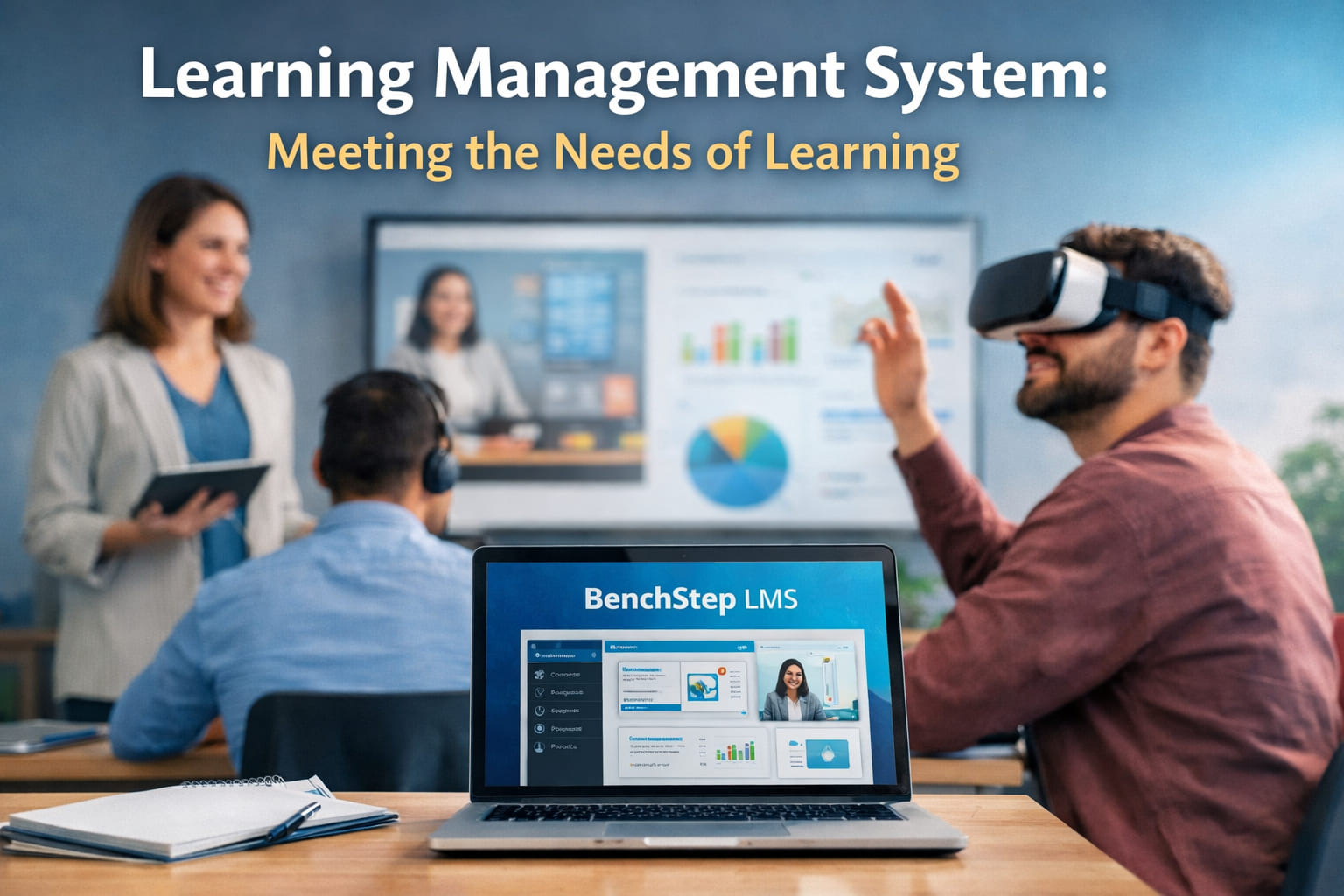
LMS vs Traditional Training: Why Digital Learning Wins

Introduction
For decades, training meant booking a room, flying in a trainer, printing materials, and pulling employees away from their work for hours or even days. It was expensive, hard to scale, and nearly impossible to measure properly.
Today, organizations have a better option: a Learning Management System. The debate between LMS and traditional classroom training is still alive across organizations of all types, so in this blog we break down the real differences and explain why digital learning consistently comes out ahead.
What Is Traditional Training?
Traditional training, often called instructor-led training or ILT, involves a trainer delivering content to a group of learners in a physical setting. Think classroom workshops, printed manuals, in-person role plays, and fixed schedules tied to a single location.
ILT has real value, especially for hands-on or interpersonal skills. But in a modern, distributed work environment, its limitations become very difficult to ignore.
A Side-by-Side Comparison
Cost
Traditional training stacks up costs fast. Venue hire, travel, printed materials, trainer fees, and the productivity lost while employees are out of their seats. Every new batch repeats those costs. An LMS requires upfront investment but dramatically reduces the per-learner cost as you scale. Once content is built, it runs indefinitely.
Flexibility
Classroom training ties learners to a fixed time and place. An LMS lets people learn at their own pace, during a commute, over lunch, or first thing in the morning. That flexibility pushes completion rates up and disruption to daily work down.
Consistency
With ILT, training quality varies depending on the trainer, the group, or even the day. An LMS delivers the same content to every learner, the same way, every time. No gaps based on who ran which session.
Scalability
Onboarding 10 people and onboarding 1,000 people take roughly the same effort on an LMS. Traditional training needs more trainers, more venues, and more budget every time headcount grows.
Tracking and Accountability
Traditional training relies on sign-in sheets and self-reporting. An LMS logs everything automatically: completions, scores, time spent, engagement. Managers get real-time data, not guesses.
Content Updates
Changing a printed training manual means reprinting and redistributing everything. Updating an LMS course means editing one file and every learner sees the latest version immediately.
When Traditional Training Still Makes Sense
ILT is not dead. There are areas where it still adds genuine value: complex hands-on skills that need physical demonstration, sensitive topics where in-person dialogue matters, and team-building activities that depend on group dynamics.
The most effective organizations often combine both. They use an LMS to cover foundational knowledge at scale and bring in ILT for the applied, human-centered work. That blended approach gets the best of both.
Why Most Organizations Are Choosing LMS
Organizations using LMS platforms consistently see lower training costs per employee, faster onboarding, better knowledge retention compared to one-time sessions, cleaner compliance tracking, and higher learner satisfaction because people can learn on their own terms.
In a world where skills shift quickly and teams are spread across locations, an LMS is not just more convenient. It actually performs better.
Conclusion
This comparison is not really about which model is superior in a vacuum. It is about which one fits the demands of a modern organization. For scale, consistency, cost-efficiency, and accountability, the LMS wins clearly.
Organizations that stick to classroom-only training risk falling behind on talent development and compliance readiness. The shift to digital learning is not a passing trend. It is where things are headed.
Make the Switch with BenchStep LMS
Ready to move past the limitations of classroom training? BenchStep LMS helps organizations deliver structured, trackable, and engaging learning experiences at any scale. Whether you are replacing traditional training or building a blended program, BenchStep gives you the tools to do it right. See how BenchStep LMS can drive measurable learning outcomes at your organization.
FAQs
Is an LMS better than classroom training?
For scalability, cost, consistency, and tracking, yes. For hands-on or interpersonal skills, a blended approach combining both tends to work best.
Can an LMS replace instructor-led training entirely?
Not always. LMS excels at knowledge delivery and self-paced content. ILT still works well for skills that need physical practice or in-person interaction. Many organizations use both.
How does an LMS improve consistency?
It delivers the same content to every learner in the same format, removing the variability that comes with different trainers, batches, and locations.
What is blended learning?
It is a combination of self-paced eLearning through an LMS and live instructor-led sessions. Learners get flexibility without losing the benefit of direct human interaction.